
In 1835 Quetelet incites Plateau to seek the appointment of professor of physics at the University of Ghent. The same year he is appointed. He teaches the physics course. Even before he teaches his first course (15 January 1836) he asks the Rector of the University to reduce the number of hours he has to teach to 3 a week, in view of his bad health (result of his chemistry experiments in Liège). He manages to attract a large number of students to his courses, which is remarkable, since before him physics as taught in Ghent was rather boring. Three extant manuscripts, noted by students of Plateau give a clear insight in the subjects he treated. The course is neatly divided into chapters (something unusual for that time) and based mainly on experimentation. The contents of the "cabinet de physique" perfectly complement the course.

Hydrostatic balance made by Pixii (Paris) bewteen 1815 and 1835.
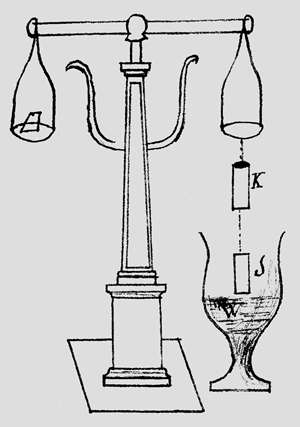
Drawing by César Alexandre Frédéricq, student in 1839-1840.
University Library Ghent.


The manuscript by C.A. Frédéricq contains very detailed drawings, and gives a good insight into the subject matter treated by Plateau.

After Plateau goes blind in 1843, he is unable to teach from 1844 onward. The university gives him permission to continue to give lessons at his home. His situation however remains difficult: political changes in government, opposition from H. Valerius (1820-1897) who teaches physics in Plateau's place and who fails to obtain tenure all make favourable retirement difficult. When finally Valerius is appointed full professor, all the tensions disappear. Plateau continues to teach at home and keeps his salary. The experiments performed by Plateau after 1844 certainly justify this extraordinary arrangement.

Before Plateau's arrival, the Physics Laboratory was in a sorry state ("très arriéré"). Plateau finds the necessary funds with the Belgian government and with Count Jean-Baptiste d'Hane (administrator of the University). He undertakes many travels abroad, to place orders with the best European instrument makers of that time. In 1831, 1833, 1836 and 1838 Plateau is in Paris. He contacts several physicists (Nobili, Babinet, Arago,...). The registers of the laboratory show the purchase of a cylindrical lens, a calorimeter, a hair-hygrometer, an apparatus with 7 mirrors to recombine light, a brass reflector for Leslie's experiments, a helium thermometer, a camera lucida by Nachet, etc. Indeed a very diverse collection, which shows that Plateau buys for all the branches of physics. In 1837 he obtains a special grant to go to London. He brings home "five cases of merchandise". In 1839 or 1840 he goes to Germany and in 1840 again to Paris. After these numerous trips Plateau proudly writes to minister Jean-Baptiste Nothomb (1805-1881) that the laboratory is now one of the best equipped in Europe.